

|
Surely the holiest city of all, we came to Jerusalem on May 15, 2000, traveling here from Amman, Jordan. Intensely spiritual, and crowded with pilgrims of all faiths, Jerusalem is a remarkable cauldron of religion and history. As home to the holiest sites in each of Judaism and Christianity, and one of the holiest sites in Islam, the roughly 2 square kilometers that make up the old walled city of Jerusalem have been called the most interesting in the world. Jerusalem is essentially two parts. The old city is walled and within it are most of Jerusalem's historical attractions. While administered and policed by the Israelis, the old city is inhabited principally by Arabs. In contrast, and as its name suggests, the New City (also referred to as West Jerusalem) is modern and new, and holds the heart of the Jewish community in Jerusalem.
The Old City of Jerusalem is completely enclosed with thick, tall, stone walls, some which still bear significant pock-marks resulting from artillery and bullets fired during the many wars and battles contesting this city. Seven gates are open, providing the access to the Old City. The gate shown here is Damascus Gate, which opens up to the hectic congestion of the Muslim Quarter.
The Church of the Holy Sepulchre is jointly "owned" and administered by a variety of different Christian sects: Armenian, Greek, Copt, Roman Catholic, Ethiopian, and Syrian. Each sect has differing chapels and administers different portions of the Church.
A small door to the Ethiopian monastery. Interestingly, Jerusalem is home to a thriving community of Ethiopian Christians.
The principal doorway to the St. James Cathedral in the Armenian quarter of Jerusalem.
Orthodox Jewish man at prayer beside the Western Wall.
The full cross-section of the Jewish community, including soldiers shouldering automatic weapons, comes to pray at the Western Wall.
Continue to Page 2 for more photographs of Jerusalem
|
|
2 Go Maps / 2 Go Actual Itinerary / 2 Go Photos / 2 Go Home Page
PLEASE E-MAIL US. . . WE WOULD LOVE 2 HEAR FROM YOU!
©1999-2001 Kelly and Rich Willis. All rights reserved. |
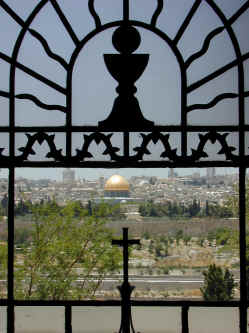 The
Old City of Jerusalem, as seen from the Dominus Flevit Chapel on the Mount of Olives. In the foreground
is the Jewish cemetery, considered by many Jews to be the holiest place to be
buried as the place closest to where the resurrection of mankind will occur on
the day of judgment. In the center of the photo is the gold
dome of the Dome of the Rock. The Old City is essentially divided into
four quarters: the Muslim Quarter, the Christian Quarter, the Armenian Quarter,
and the Jewish Quarter.
The
Old City of Jerusalem, as seen from the Dominus Flevit Chapel on the Mount of Olives. In the foreground
is the Jewish cemetery, considered by many Jews to be the holiest place to be
buried as the place closest to where the resurrection of mankind will occur on
the day of judgment. In the center of the photo is the gold
dome of the Dome of the Rock. The Old City is essentially divided into
four quarters: the Muslim Quarter, the Christian Quarter, the Armenian Quarter,
and the Jewish Quarter.
 The gray domes of the Church of the Holy Sepulchre,
considered by many to be the most holy place in all of Christianity as it venerates
the site generally agreed to be where Jesus Christ was crucified, buried and resurrected.
The gray domes of the Church of the Holy Sepulchre,
considered by many to be the most holy place in all of Christianity as it venerates
the site generally agreed to be where Jesus Christ was crucified, buried and resurrected. 


 The Western Wall, also known as the Wailing Wall, is the holiest
site in all of Judaism. Operating as a great open-air synagogue, at all
times of day people come to pray here. They can often be seen with
prayer-book in hand, bowing repeatedly and rhythmically toward the wall while
reciting prayers, while others insert prayers written on paper into cracks in
the Wall. This photo is taken on Friday as sundown approaches. Shabbat, which occurs from sundown
Friday to sundown Saturday, is a holy day for Jews upon which no work is to be
done. And at the Western Wall it is ushered in with a large crowd (by the
time of sundown, the entire area in front of the Wall was crowded with people)
praying and, at times, singing. While solemn, the atmosphere is also
celebratory and festive. It was an amazing thing to see and
experience.
The Western Wall, also known as the Wailing Wall, is the holiest
site in all of Judaism. Operating as a great open-air synagogue, at all
times of day people come to pray here. They can often be seen with
prayer-book in hand, bowing repeatedly and rhythmically toward the wall while
reciting prayers, while others insert prayers written on paper into cracks in
the Wall. This photo is taken on Friday as sundown approaches. Shabbat, which occurs from sundown
Friday to sundown Saturday, is a holy day for Jews upon which no work is to be
done. And at the Western Wall it is ushered in with a large crowd (by the
time of sundown, the entire area in front of the Wall was crowded with people)
praying and, at times, singing. While solemn, the atmosphere is also
celebratory and festive. It was an amazing thing to see and
experience.