|
Damascus was a wonderful city to explore. With all of the principal sites within easy walking distance of one another within a charming old city, with an extremely friendly local population, and with relatively few tourists, it was great to visit. We came here from Jordan in a somewhat painless bus ride from Amman. As we hoped, crossing the border was not a problem--the border officials looked for evidence of a visit to Israel in our passport but, finding none, allowed us to pass without question.
Our first sight was the Umayyad Mosque--one of the most sacred sites in Islam. It is an impressive and beautiful structure--richly decorated still, giving a glimpse of its former grandeur. This is a view of the enormous central courtyard.
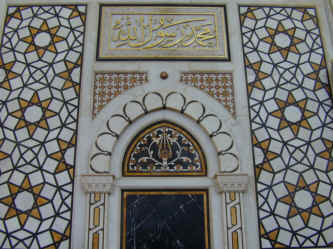
The Umayyad Mosque is home to exquisite mosaics and beautiful inlaid marble work, as shown here. In the Islamic faith, depictions of man in worship is forbidden--so instead, mosques are decorated with rich geometric patterns (as seen here), floral patterns, and Arabic script. All quite beautiful.
Afternoon prayers at the Umayyad Mosque. Strict Muslims pray five times a day--sunrise, noon, mid-afternoon, sunset, and night--and throughout the Islamic world you can here the prayer calls bellowing through the streets at such times. And except for noon prayers on Friday--the Islamic holy day--it is not necessary to come to a mosque to pray.
One of the most fascinating sites in Damascus--indeed, in all of Syria--was the Sayyida Ruqayya Mosque, which is an Iranian mosque built in a typical Iranian building style. Kelly had to wear a long, hooded, black robe to enter (similar to those worn by the women shown here), and once inside we were greeted with some very intense worship. The women, in particular, seemed most devout, as they prayed, cried, and beat their chests as they sat cross legged on the floor deep in prayer. It was actually intimidating, albeit a fascinating glimpse into the Islamic faith and culture.
The ubiquitous presence of President Hafez al-Assad, this time appearing in the Souq al-Hamidiyya, the old city's main covered market. The souqs--or markets--in Damascus were the most authentic we had seen; day to day commerce taking place in spices, clothes, vegetable, tools and candy, instead of the relentless hawking of trinkets to tourists. Which is not to say there were not tourists--just few of them. Indeed, it seemed as though there were more Arabian tourists--from Saudi Arabia, for example--than western tourists. The visage of Hafez al-Assad can be seen everywhere--and now probably more so since his death. Having ruled Syria with a heavy hand for roughly 30 years, his absence cannot help but bring change and, perhaps, turmoil. But he seemed to be beloved by his people, so it will be interesting to see what develops, and how is son--who is to be the new leader of the Syrian nation--fares.
One of the great treats of Damascus is ice cream at Beckdach. The place does nothing else but churn out vanilla ice-cream (hand-made on the premises) hand rolled in pistachios. It looks to seat about 300, and is always packed. The ice cream was wonderful and, at about $0.50usd for a bowl that looked to be more than half a pints worth of ice-cream, it was an absolute bargain.
The people of Syria are the friendliest we have met anywhere else in the world. Their hospitality--as in all of the Middle East--is legendary. Everywhere complete strangers invite you to sit, talk, and have tea. And there isn't a catch, unlike, say, Egypt. Nothing to sell, they just want to be friendly. While walking around the old city, the large man in the center noticed us reading our guidebook from the window of his home and invited us inside for tea. While these men spoke little English, we had a great time enjoying their hospitality.
One night in Damascus we enjoyed a great dinner with some wonderful entertainment--traditional Syrian music together with the performance of Whirling Dervishes. As a mystical order of Islam, the dervishes worship, in part, through dance, spinning and spinning. It was great fun.
Following our visit in Damacus, we traveled to the ancient Roman
city of Palmyra.
|
|
2 Go Maps / 2 Go Actual Itinerary / 2 Go Photos / 2 Go Home Page
PLEASE E-MAIL US. . . WE WOULD LOVE 2 HEAR FROM YOU!
©1999-2001 Kelly and Rich Willis. All rights reserved. |